
The Park is situated on the Pajarito Plateau which was formed by volcanism in the Jemez Mountains northwest of here 1.2 and 1.6 million years ago. Layered on top of an older basalt flow these rocks are tuffs, pyroclastic flows, and pumice. The tuff along the cliff dwellings were full of cavities, vertical tubes, and small holes which were the result of gas vents expulsing to the surface. The tuff can be mined for building blocks, carved out for rooms, and easily etched for petroglyphs. Combining this with the clear water of Frijoles Creek, abundant game, and arable land the prehistoric people found a perfect spot to live.


Hiking up Frijoles Creek one first comes to Tyuonyi (QU-weh-nee) village. When occupied the circular adobe village had 400 rooms and 3 kivas and was two stories tall and housed around 100 people. The surrounding caves were also inhabited at the same time bringing the total to 300-500 people during the interval of 1300-1500 years ago.
Outside of the obvious living quarters the first floors were used to store grain and some were used to raise turkeys. The turkey feathers were twisted with yucca plants to make blankets, socks and warm clothing items.
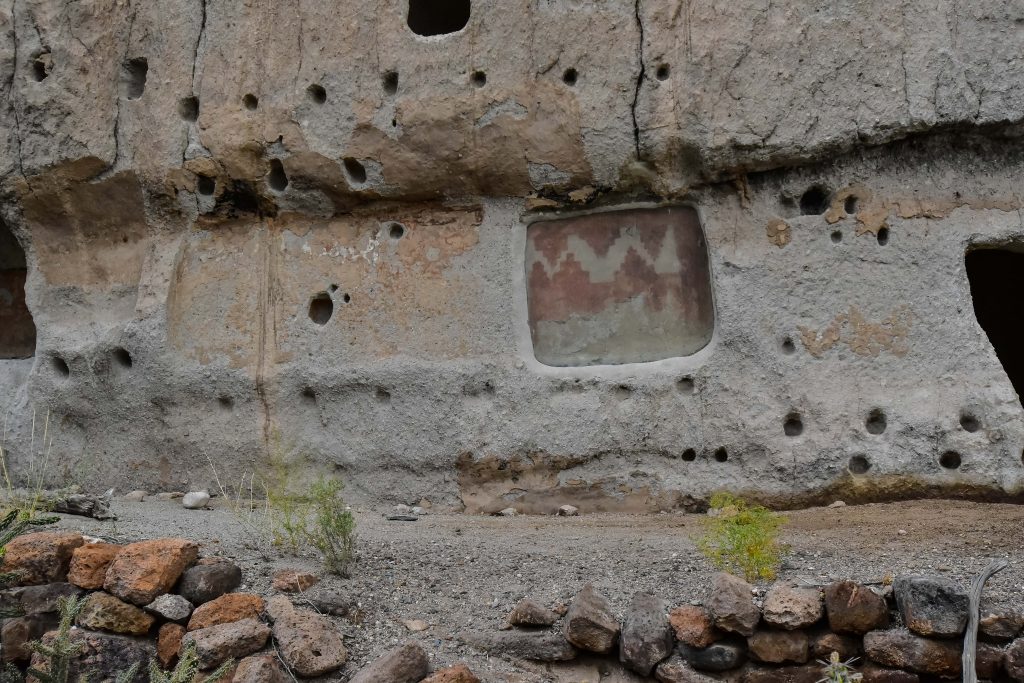


We continued another one half mile up the canyon to the “Long House” where we had to climb up 140 feet on straight ladders to reach the house. The ladders are bolted into the tuff and are nearly vertical. Unlike hiking, going up and going down was a challenge but we made it! Our early start made us the only ones on the trail.
Returning to the lodge we found the parking lot full of cars, tour buses, and two school buses. The moment the café opened we split an elk cheese burger and hightailed it to campsite 30 on Black Bear Loop just beating the rain that let loose around noon.


